
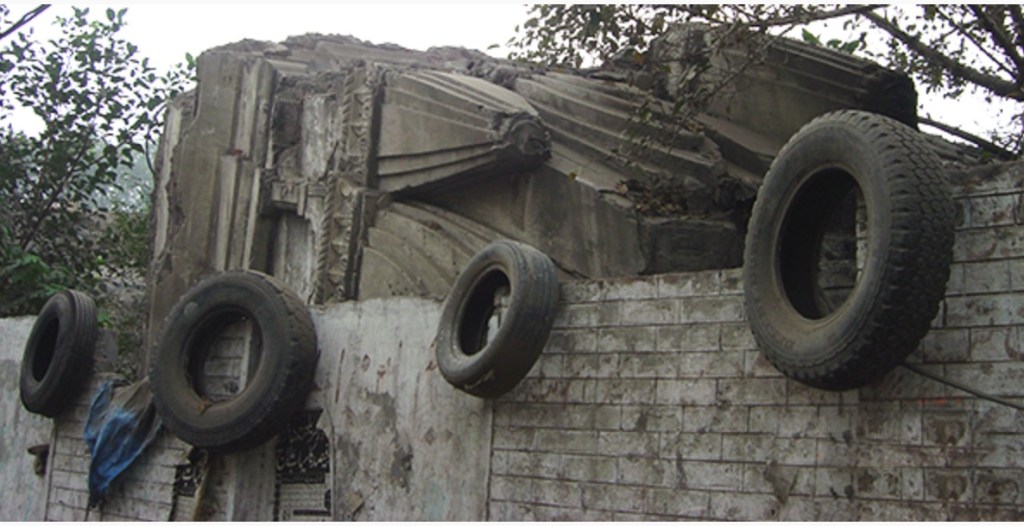
When I first approached my uncle about encountering Jain Mandir in the heart of Lahore, he recalled his journey to college to me. When he took the bus from Garden Town in the suburbs, Jain Mandir Bus Stop was an important depot on his way to Government College University. He, of course, knew very little about the namesake of that bus stop. The scattered remains of the temple were there for many years, even before its decimation in 1992. Indeed, when Lahore was vacated of its Jain population in 1947, the temple complex went through many transformations. Slowly its rooms were separated and the land distributed to various people. Some of the land became a madrassah, a small religious school. Other land became shops and markets; even a small Sufi shrine comprises the extent of Jain Mandir. It is unclear whether the bureaucratic departments responsible for Jain Mandir sold off this land or if they collected revenue on it. In any case, there was no effort to repair or protect the remaining turret in the aftermath of 1992.
The decay of the site of Jain Mandir began shortly after Partition, yet its name and presence continued to persist in, and haunt, the city in the decades after, despite there being no Jain place of worship there. That site continued to be referred to as the namesake bus stop or even as Jain Mandir Chowk (square). Here I raise Jacques Derrida’s concept of hantologie or hauntology, which he describes as the persistence of ghosts–conceptual and metaphorical–in present time. This veritable “haunting” of the present, a sly play on ontology, comes from what is absent and yet still influential, like a repressed historical trauma. Unlike traditional ontology (the study of being), hauntology deals with non-being—what is no longer (or not yet) present but still affects the environs. It is that space of haunting that Jain Mandir occupies on that intersection, a decaying carcass sublimating the real violence that was vented on its walls and the metaphorical violence in the aftermath of 1992, the project of forgetting Jain Mandir’s place and importance in the city. I argue that Jain Mandir’s ontological non-being as a carcass, while still being referred to or understood as a temple, suspends it in linear time, disrupting the illusion of a stable present. Thus, the lack of state intervention and the resultant status quo of decay means that both the past and the future haunt the present.
Underneath the turret of Jain Mandir (2011)
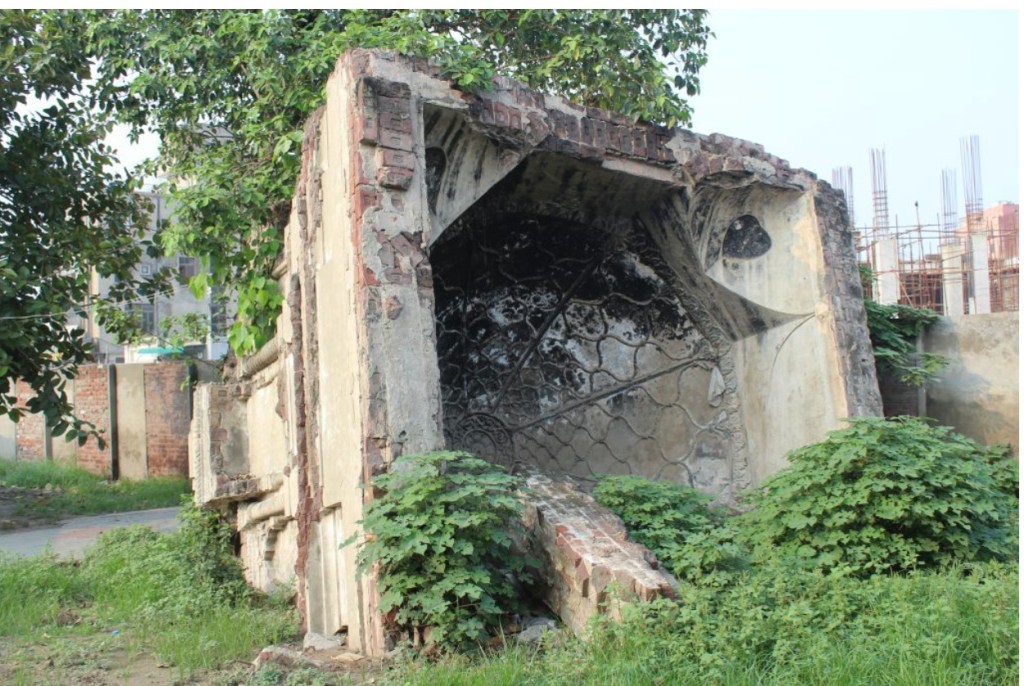
Another important meaning here is the significance of urban ruin. Jain Mandir was difficult to miss in the spectacle of its ruination, right in the middle of one of Lahore’s busiest thoroughfares. Andreas Schönle describes this power of urban ruin, asserting that it “derives its power and promise from its refusal to be assimilated in the surrounding symbolic order” (Schönle 2006). A decaying turret, a shikhara not visible in Lahore’s contemporaneous spatial landscape, contained within a busy intersection perhaps embodies that power, inviting passers-by a moment of consideration of its history.
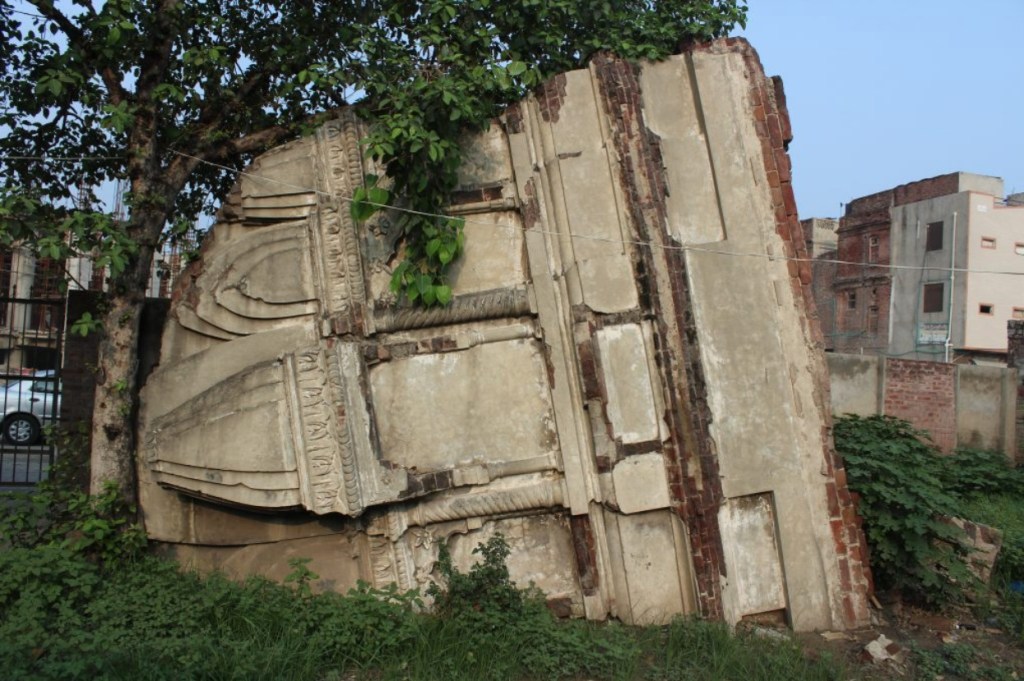
A ruined structure derives its power and promise from its refusal to be assimilated in the surrounding symbolic order
Scho ̈nle, Andreas (2006) Ruins and history: Observations on Russian approaches to destruction and decay (46)
According to Susan Stewart, ruins are “embodiments of the process of remembering” (Stewart 1996). Indeed, ruins do not offer a fixed or official history; instead, they evoke an ongoing engagement with memory. They prompt us to reconstruct, imagine, and question the past rather than passively receive it. Because ruins are tangible and material forms that carry traces of the past, their fragmented nature invites interpretation and reflection, unlike intact monuments. Considering Jain Mandir’s temporality, I argue that its ruins offer a “pluritemporal” landscape where layered histories can intersect (Crang and Travlou 2001). Again, the experience of time at Jain Mandir’s ruins is non-linear, where multiple histories of the place are overlaid and experienced collectively.
The spatial landscape of Jain Mandir is thus a palimpsest, made even more significant by the state’s veritable rewriting of it in December of 2021, which I explore next.
 The Death of Jain Mandir